


Safe Link Building in 2026: What Google Still Punishes
Posted by Nazar Ivaniv
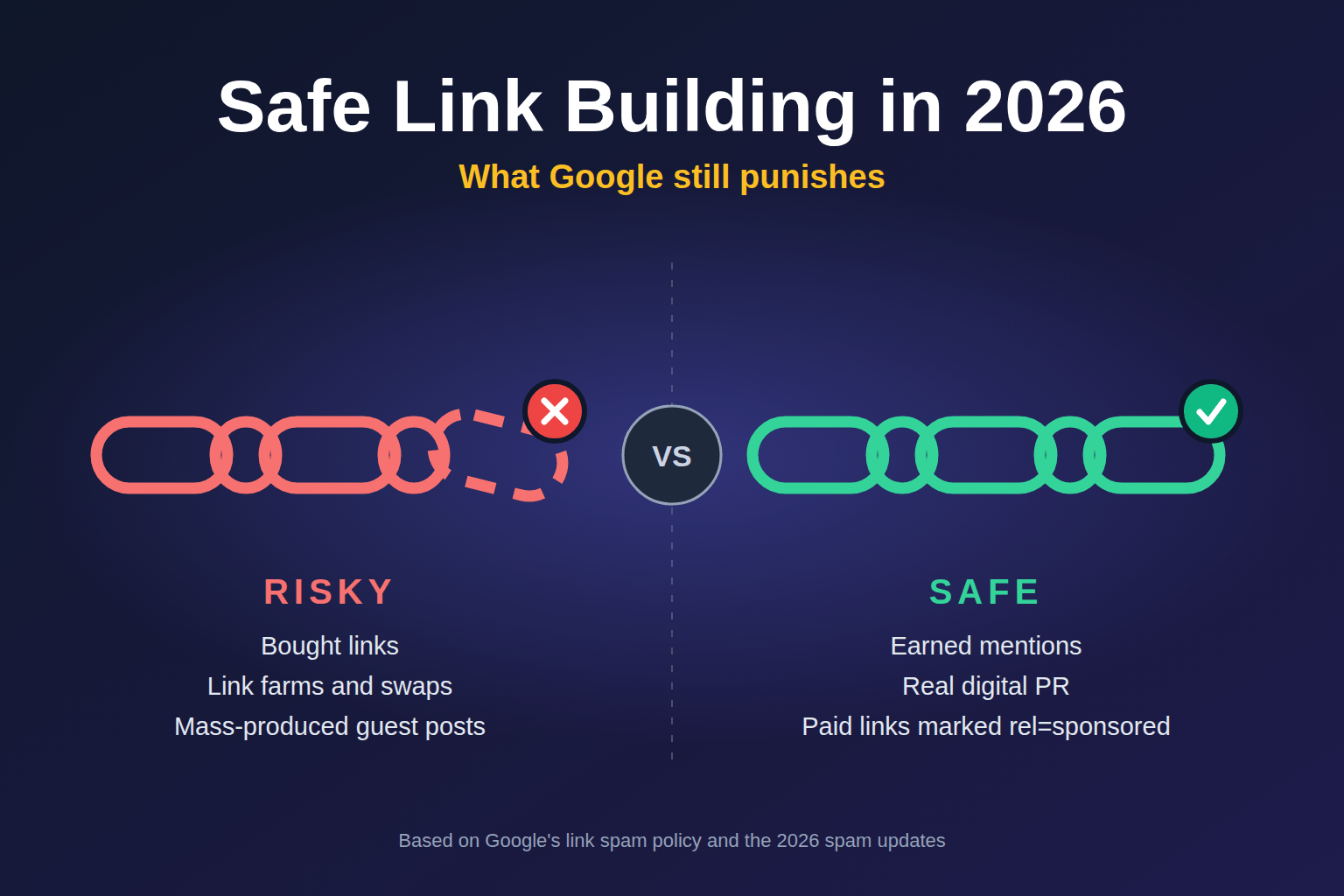
Google insists that its spam updates are not about links. Meanwhile, penalty specialists are getting busy again. Here’s how to interpret this and what to do about it.
In early October, I came across something posted by Marie Haynes that caught my eye. Having spent about two decades helping sites recover from Google penalties, she told Barry Schwartz of Search Engine Roundtable that her requests had increased from virtually none to several per week. She had not advertised this type of work for years.
The detail that stood out was that most of those sites were legitimate, long-standing businesses. Not churn-and-burn spam farms. They were ordinary companies that took a shortcut with an agency or tool and then relaxed because nothing bad happened for a while.
4Google spam updates so far in 2026
14 daysPlanned length of the September rollout
143Near-identical county pages in one reported case
0of the 2026 updates reported as aimed at link spam
There were four updates, and nobody could blame the links.
March took about 19 hours to complete. June took a little over two days. August took place from the 18th to the 21st. Then, on 24 September, Google posted a two-sentence note saying that the next one could take up to two weeks. Distribb, which tracks these updates, has only recorded one in all of 2025.
Barry Schwartz asked every time whether links were the target, and the reporting came back the same each time: not link spam and not site reputation abuse. Google’s September announcement names no target at all.
So, who was affected? Pages. On 28 September, Lily Ray wrote that the early signs pointed to highly templated, programmatic pages that were probably made using AI, such as a page for every phone number or area code. Glenn Gabe described a similar pattern: a traffic mountain that climbs and falls quickly. Distribb also shared an example of 143 county service pages created from one template.
Spam update rollouts in 2026, in days
March~19.5 hours
June~2 days
August~2 days (Aug 18–21)
Septemberup to 14 days
The reason why ‘not about links’ is a trap.
Google has a long-standing approach to links. In December 2022, the link spam update was introduced, giving SpamBrain the job of identifying sites that buy links and those that pass them on, and then cancelling the credit. Note the verb. Google doesn’t usually penalise bad links. It simply stops counting them. You never receive an email. You just paid for nothing.
One link vendor says the same thing about cheap placements: they are increasingly being ignored rather than penalised. Bear in mind that they sell digital PR, so they have a vested interest in saying it.
Humans are another matter. The manual action list posted by Daniel Foley Carter on 7 October still includes ‘unnatural links to your site’ and ‘unnatural links from your site’, alongside thin and scaled content. If a person looks at your site and sees a pattern, the penalty can reduce your traffic by a significant amount overnight.
Also, links are rarely alone. The article carrying it is considered to be ‘content’, and Google’s spam policy covers low-value content created primarily to manipulate links. A bought post that nobody would read presents both problems at once.
One honest caveat: The rise in manual actions is anecdotal. Schwartz asked ChatGPT and Gemini to chart forum complaints, and the two sets of data disagreed. Treat it as a warning light, not an accurate measurement.
This is what people on X are saying:
Marie Haynes (Oct 7): reports a jump in manual-action help requests, mostly thin content, pure spam and scaled content, from “legitimate long standing businesses.”Post on X
Daniel Foley Carter (Oct 7): blames an industry that went for scaled-content shortcuts, and says it is “pay cheap pay twice.” He adds that some sites lose over 90% of traffic overnight.Post on X
Lily Ray (Sep 28): early signs the update hits templated, programmatic pages. Replies: one person asked whether those pages also lose AI Overview citations, another joked that local SEOs with city pages are sweating.Post on X
Bree Sharp (Aug 18, reply to Lily Ray on a thread about spam updates): her take on why updates keep coming is that people pivot to the next tactic, and “the bar just keeps moving.”Thread on X
The same rulebook now applies to AI answers.
On 15 May, Google updated the introduction to its spam policy. Spam now includes attempting to manipulate generative AI responses in Search, including AI Overviews and AI Mode. The wording is broad and is thought to be aimed at paid citation schemes, fake mention networks, and listicles written to bait AI answers (Stan Ventures). However, Google has not confirmed which update enforces this.
The practical point is simple. If a tactic only makes sense because it might get you quoted by an AI, it now sits in the risk zone. Treat AI visibility as a result of being a real source, not a separate game in itself.
Link tactics by how much trouble they can cause
| Tactic | Risk | Why |
|---|---|---|
| Original data or research pitched to journalists | Low | A writer chose to cite you. Nothing to hide. |
| Reclaiming lost links and unlinked mentions | Very low | Often fixes your own redirects. |
| Guest posts on relevant sites with real editors | Low to medium | Fine in small numbers. Google flags large-scale article campaigns. |
| Tiered links, exact-match anchors in volume | Medium to high | Easy pattern for SpamBrain to cluster. |
| Paid posts without rel=”sponsored” | High | Google asks for sponsored on paid links, nofollow on guest-post links. |
| PBNs, bulk marketplaces, expired-domain content | High or wasted | Expired domain abuse is a named policy. |
| Fake mentions to bait AI answers | High | Covered by the May 15 policy change. |
What to do before the end of the year:
- Measure from Search Console only. Ahrefs has posted a notice stating that its SERP data may be inconsistent following changes to the way Google serves results. Make a note of your position on 24 September, wait for the rollout to finish, and then compare page groups rather than single URLs.
- Run the swap test. Distribb suggests asking yourself the following question: if I change the keyword in the title, will the rest of the page still make sense? If the answer is yes, either merge or remove it.
- Improve the way you tag links. Paid or affiliate links should have rel=”sponsored”. Guest-post links should be nofollow. Also, take a look at your anchor text: lots of exact-match anchors is a pattern.
- Reclaim before you buy! Check lost links monthly and follow up on unlinked brand mentions. This takes time, not budget.
- Create one piece of data per quarter. It could be a survey, a dataset or a test. Pitch it to writers who cover your topic. This method is slower than a marketplace, but it is the one that every source here calls safe.
- If you are hit, clean up and wait. Google says that recovery can take months. Glenn Gabe showed a site that was hit in August and went from almost no clicks to around 8,000 a day during September’s evaluation period (as reported by Distribb, a content software seller).
The short version
Google is not telling you to fear links. It is telling you to be wary of patterns: using the same template, anchor and placement repeatedly until someone or SpamBrain notices. The links that survive every update to this page are the ones that a stranger would have added of their own accord.
Sources
- Search Engine Roundtable: Is Google issuing more manual action penalties? (Oct 8, 2026)
- Search Engine Roundtable: September 2026 spam update weekend impact
- Distribb: September 2026 spam update, what got hit, what came back
- SEO-Kreativ: March 2026 spam update
- Google Search Central: December 2022 link spam update
- Gizmodo: Google’s spam policies now apply to attempts to manipulate AI (May 15, 2026)
- Stan Ventures: 7 Google spam updates later
- Search Engine Journal: Google link spam update
- Growwer: September 2026 spam update and link building
- Reporter Outreach: backlink pricing
- Ecomexperts: Safe link building guide
- LinkBuildingHQ: Backlink acquisition in 2026
Related posts

9 App Ideas for App Builders Starting With AI Tools

6 SERP Features Quietly Stealing Clicks from Your Practice

How to Write B2B Website Copy That AI Answer Engines Can Trust

The 6 Best Hosting Providers for eCommerce Security

SEO in Daily Life: Lessons/Tricks for Better Web Navigation

There are currently no comments.
Be the first!))